
What’s going on with my blood sugar? A brief overview of insulin resistance.
By Sarah Petty
This blog is for education purposes only. I have a master's degree in nutrition and a reasonable understanding of insulin resistance physiology. I am not a doctor. Please review any information that you feel is relevant with your primary care provider, and do not consider this medical advice.An analogy I like to use when describing the body and its systems is that of a forest. A forest can be mistaken at first glance as simply a collection of trees. However, anyone who’s spent time in a forest knows they are entire ecosystems, with many interactive parts. Like a forest, your body is an entire ecosystem. Everything is connected.
A forest path at Signal Rock near Glencoe, Scotland.
Because everything’s connected, blood sugar (glucose) regulation is a complex series of actions taken throughout your body. It’s a delicate dance of skeletal muscle, hormones, organs, and more. Your body works incredibly hard to keep the amount of glucose in your bloodstream within a fairly narrow range. When your blood sugar is suddenly outside the range, it’s a sign that your body is no longer able to maintain homeostasis.
That’s why you don’t just wake up one day with blood sugar issues as an isolated event. That would be like an instantaneous forest blight or burn - only the most catastrophic of events could cause that. For most people, regardless of if or when you experience symptoms, insulin resistance as well as type 1 and type 2 diabetes don’t develop overnight. They are the surface level experience (symptoms) of understandable and predictable patterns in your body’s ecosystem.
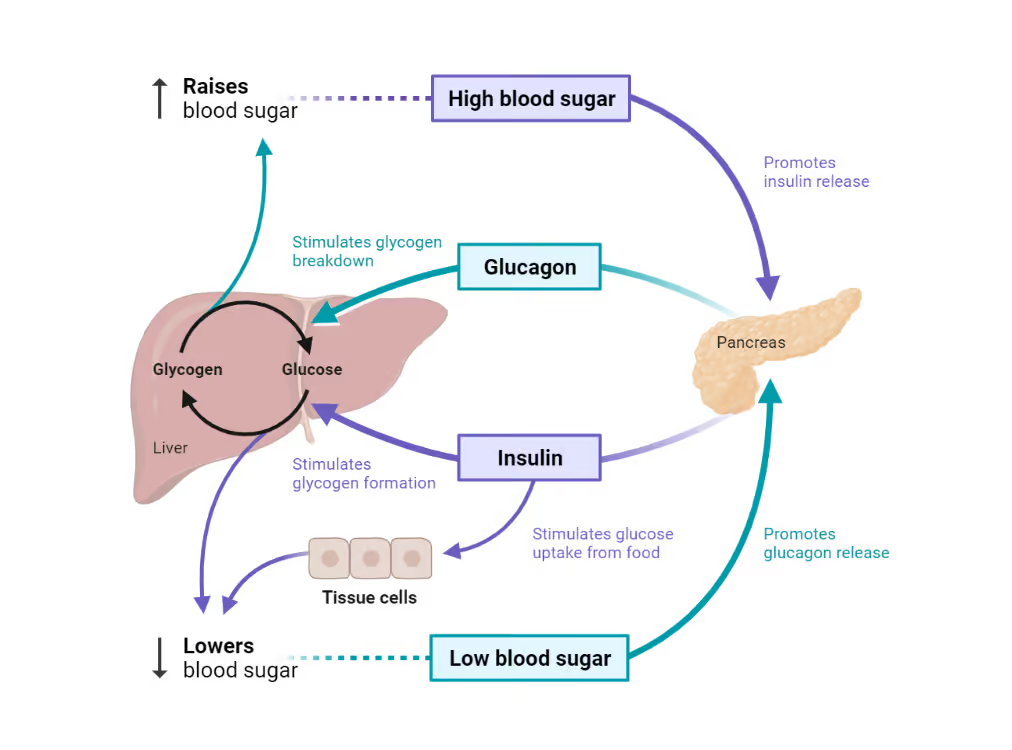
In the simplest of terms, the amount of glucose/sugar in your blood is kept in that narrow range by the hormones insulin and glucagon. Insulin (released by the pancreas) is a key that unlocks cell membranes (primarily skeletal muscle cells, but also liver and fat cells) for glucose/sugar, allowing it to move from the bloodstream to inside the cells. After any increase in glucose in the blood (from eating, adrenaline dump, medication, etc.), the pancreas releases insulin to get the levels in the blood back to normal.
In contrast, if the amount of glucose in the blood drops below normal, the pancreas releases glucagon. Glucagon tells your liver to release stored glucose, gradually bringing your blood glucose levels back to normal. When everything is working as it should, this cyclical process constantly runs in your body, keeping your blood sugar regulated.
So what does it look like when this system stops working? It’s a gradual process, often years in the making, and occurs in phases. There are five stages of type 2 diabetes, and three stages of type 1 diabetes. Diagnosis does not occur at the first stage, which means you can be on the path to a diagnosis long before you have one. And even if you never have a diabetes diagnosis, impaired glucose regulation (insulin resistance, or other metabolic/endocrine syndromes) can create long-term problems for your brain, heart, and energy systems.
The more you know what to look for, the easier it is to catch and treat insulin resistance. And in most cases with proper treatment, insulin resistance does not continue to progress.
Symptoms of mild to moderate insulin resistance:
frequent hunger or food cravings
weight gain or change in body shape/composition
acanthosis nigricans (velvety patches of discolored skin)
consistent fasting glucose of 90-117 mg/dL (this range varies based on which medical professional or organization you ask)
fatigue after meals
problems with attention, memory, and focus
worsening of existing anxiety and depression
general fatigue due to inconsistent energy availability
reactive hypoglycemia (extreme fatigue, dizziness a couple hours after eating)
Where does insulin resistance come from?
Before those symptoms and experiences can happen, there are events and conditions that trigger them. I’ve categorized these as “singular” or “direct” (like clearing a section of trees in the forest), and “chronic” or “indirect” (like an upstream wastewater dump slowly poisoning the forest). The following are events/actions/experiences that impact blood sugar regulation.
Singular/Direct
traumatic event
gum disease
Cushing’s
impaired gut microbiome
PMOS/PCOS
pregnancy
injury/illness causing immobilization
extreme weather
staying up all night
dehydration
smoking
high volume alcohol consumption
Chronic/indirect
skipping meals or excessive meals
consistent high caffeine intake
low sleep quality, or quantity
high volume of sitting (desk job, school, TV, etc.)
frequent, low volume alcohol consumption
certain medications, including steroids and antipsychotics
frequent sunburn or sun exposure
autoimmune disease
high-stress life (abuse relationship, toxic job, etc.)
aging
I’m sure I’ve left some out, but you get the idea. Personal decisions, unavoidable diagnoses and experiences, and even the privilege of aging can impact your body’s ability to keep your blood sugar stable. Some of these things are completely outside your control. And, there are some things that you can do (or NOT do) that make a big difference. In my next blog, I’ll share how movement is a somewhat magical tool that can improve insulin resistance regardless of your weight or your diagnosis.